




Listen
Live On The Air
Archives - Previously Aired
Program Schedule
Program Information
Donate
One-Time Cash Donation
Donation With Thank-You Gift
Monthly Donation - BAI Buddy
Ways to Donate
Get To Know Us
About Us
Staff
Mission
Pacifica Foundation
Local Station Board
Community Advisory Board
Our Partners
Employment
Let Us Help You
Announcements
Premiums Customer Care
Submit Event To Calendar
Membership
Newsletter Archives
Subscribe To Newsletter
Help Us
Volunteering + Internships
Marketing + Advertising
Contact Us
By Phone Or Email
Call-In Fund Drive Pledges
Directions
Eco-Logic
Wed, May 20, 2026 10:00 AM
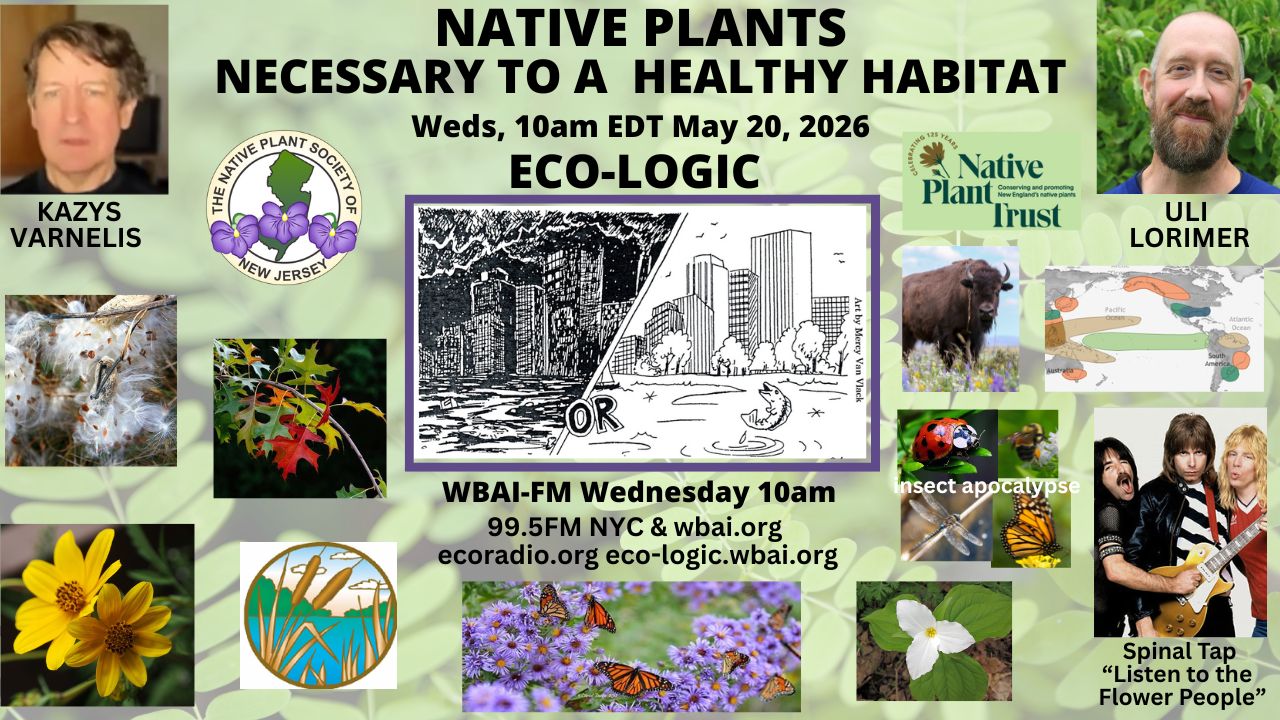
NATIVE PLANTS: NECESSARY TO A HEALTHY HABITAT
Native plants are important, even necessary, to every ecosystem, from swamps, to meadows, to forests, to your yards. The benefits of biodiversity – clean air and water, soil stabilization – are shared by all. This show connects to many other shows we've done, such as pesticides, native bees, birds, and butterflies.
Why are there so many ecologically damaging plants / invasive species out there? What was the role of Horticulture Societies, European and Asian immigration, colonialization, exoticism, and the American Acclimatization Society? How can we restore the environment to its natural and balanced state? Conversations with nurseries that sell invasives and neonicitinoids is one way.
When these ecologically damaging plants were first brought to North America, there wasn't the same recognition of biodiversity and the value of native flora. That's relatively recent, but is becoming better known. Some people even consider a native garden a status symbol. There are things to be optimistic about.
We'll discuss what makes native plants special, important, and necessary. While we're doing that, we'll also be talking about the physical, mental, and emotional benefits of going into nature. Birders walk through nature slowly, appreciate everything, and are healthier for it. Young kids are not going out in the woods enough; they are being raised to fear nature. There are more ticks because of loss of biodiversity. You know to look both ways before you cross the street, so . . . check yourself for ticks.
There are hundreds of native plants, but not all are carefully preserved yet, which leads to loss of diversity, including invertebrate diversity. Native bees need native plants. The rewilding movement is using native plants to save ecosystems.
We'll give examples of places in the listening area where you can get native plants and how to make at least part of your lawn into a native garden - thus requiring less mowing.
To quote the Native Plant Society of New Jersey, “The point is not that one place produces “good” plants and another produces “bad” plants. The point is that plants belong to ecological relationships. A responsible gardener asks what a plant does in this place: whether it spreads, whether local insects and birds can use it, and whether it strengthens or weakens the living community around it.” Plants themselves are not invading, human activities cause them to spread.
New Jersey’s Invasive Species Management Act was signed in January 2026. For gardeners, the practical point is simple: the law begins moving known invasive plants out of sale, distribution, import, export, and propagation unless a conditional-use waiver applies. The law phases in restrictions over time. Legislative statements describe a 13-month phase-in for propagation and importation and a 49-month phase-in for sale, distribution, and export. For compliance questions, use the official state guidance: https://dep.nj.gov/invasive-species/.
You should care -- you can make an impact!
Our guests:
Uli Lorimer is the Director of Horticulture at the National Plant Trust. Uli oversees daily operations at both Garden in the Woods, Native Plant Trust’s botanic garden in Framingham, Massachusetts, and Nasami Farm in western Massachusetts. He is the author of the "Northeast Native Plant Primer" and contributed as an author and photographer to several publications.
Kazys Varnelis is currently serving as President of the Native Plant Society of New Jersey. He creates and advocates for responsible landscape design and conducts transdisciplinary research and practice. He is trained as an architecture historian, working at the intersection of art, technology, architecture, sound, and the environment.
On Sunday, I (Ken) was going to a subway turnstile as an MTA employee was coming out. “I was wearing a WBAI T-shirt, the one designed by Sidney Smith "Radio With Heart!" The MTA employee saw my shirt and with a smile said, "WBAI! That was a great station!" "It still exists," I told him as I noticed his past tense. His voice had an element of surprise to it as he answered, "It still exists?" "99.5," I continued, but he made it clear he remembered our frequency. I added that he could use his phone or computer and he nodded knowingly. All of us need to let people know that WBAI is still on the air. Former listeners are really glad to know that we still exist, so tell them. If they don't know why WBAI is special, tell them! They almost certainly will be glad you did.
It's with a heavy heart that we wish to announce the passing of long-time WBAI volunteer Mitch Cohen. He had helped WBAI for decades in more ways than we can count. Many of you probably interacted with him without even knowing it. He was also an environmental activist, especially on the issues of pesticides and renewable energy. He was so ubiquitous it will probably take a long time for us not to expect to see him at a WBAI event or in the WBAI office doing volunteer work. It will probably take two or three people to make up for the work he did for the No-Spray Coalition or for WBAI. And NYC Friends of Clearwater could always count on seeing Mitchel at events. His presence will be missed.
We begin the show with news stories. This week: bison evicted from federal lands in Montana, an insect apocalypse, and more on this summer’s expected super El Niño.
Our music for you this week is Spinal Tap's “Listen to the Flower People”.
Tune in on radio or internet to get more details.
And. . .
Join us on Wednesday, May 27th, 2026 at 10 a.m. EDT.