






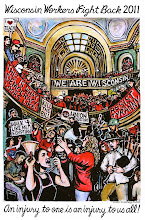
Susan Simensky Bietila is movement artist based in Wisconsin who presently works with Indigenous water protectors and allies to stop toxic mines and oil pipelines by organizing art builds and creating banners, puppets, and masks. She grew up in Brooklyn and was greatly influenced by the feminist movement of the 1960's. (For a more complete bio, see below.)
Susan is a well known political artist and illustrator, bringing her stark graphic imagery with its urgent political messaging to many movements and publications. She has just come out with a book entitled "Frontlines: A Life of Drawing Resistance", which we will be talking about in this program--and we'll be talking as well of the turbulent times that formed the movements that Susan has illustrated with her art--and continues to do.
In her struggle to forge the right to her own unconventional (by her family's standards) life, Susan was deeply influenced and strengthened -- as were so many women -- by early second wave feminism. She participated in the women's takeover for the RAT, a left newspaper that covered the Black Panthers, Young Lords and other emerging movements of the time. The newspaper was dominated by men. But in 1968, Susan received a call from a group of women who had taken over the RAT and wanted her to work with them. The women had made a deal with the male editorial collective to put out one issue themselves in order to prove that women were more than capable of producing and underground publication themselves -- and were then to turn the paper back to the men. But, as Susan said in her book: "the collective energy was so empowering, went so smoothly and was so well received, that they had decided not to give the paper back. It was obvious that women being relegated to subservient traditional roles had no place in revolutionary movements."
The Miss America Beauty Pageant Protest also happened in 1968, and women challenging the female stereotypes to which they were supposed to conform, also electrified Susan, who saw it as a 'clarion call'. In the book she speaks about having to rebel against her mothers insistence she obey 'feminine' dress codes, in order to dress ruggedly for the political demonstrations she was attending from the age of 14 on. Once again, it was the feminist movement that provided the support that she needed to disobey convention and find her own way.
Susan also had to stand up to the Art establishment of her time, having been discouraged from doing content-centered figurative art at a time when what was being taught in Art schools, was abstract expressionism.
In this program we will also speak about the various movements, including anti-war, housing, labor and others, including the environmental 'Water Protectors', which Susan now supports with her work--and the function of Art in bringing these movements to a broad audience.
We'll also talk about the importance of history itself -- the importance of women's movement history and of ALL movement history in educating and inspiring new generations to fight for a better world -- especially important at this time when all evidence of these histories is being erased by a reactionary right wing administration!
SUSAN SIMENSKY BIETILA BIO
Susan Simensky Bietila is based in Wisconsin and works with Indigenous water protectors and allies to stop toxic mines and oil pipelines by organizing art builds and creating banners, puppets, and masks. She works with social justice movements including Voces de la Frontera, Jewish Voice for Peace, Communities United by Water, and many others. (see her full biography below)
She grew up in Brooklyn and was collective member of RAT—the pioneering second-wave feminist newspaper, and later joined the World War 3 Illustrated collective, where she continues to create graphic nonfiction rooted in her activist experience. Her work has appeared in the streets and halls of power to galleries and magazines, including Fifth Estate, The Nation, and In These Times, and in books, including Anarchy and Art: From the Paris Commune to the Fall of the Berlin Wall; Wobblies: A Graphic History of the Industrial Workers of the World;and World War 3 Illustrated: 1979–2014