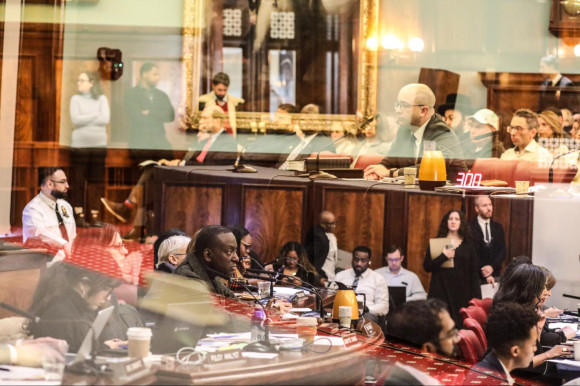
Before a City Hall hearing on the controversial buffer zone bill, which would create a security perimeter at schools and houses of worship, and lasted 10 hours on Wednesday, there were dueling press conferences in the Rotunda and on the City Hall steps.
Council Speaker Julie Menin, one of the sponsors for the five point plan, hosted the Rotunda press conference with a group of 40 people, including leaders from houses of worship like Imam Maaz Ali of Iqra Masjid.
“As an Imam, I have seen firsthand how deeply incidents of hate impact families and entire communities,” said Imam Maaz. “Our masjids, like all places of worship, should be spaces of peace, prayer, safety, and a place where people can come together as a community to strengthen their connection with one another and God Almighty…I commend the New York City Council for taking meaningful steps to confront hate and protect houses of worship across our city.”
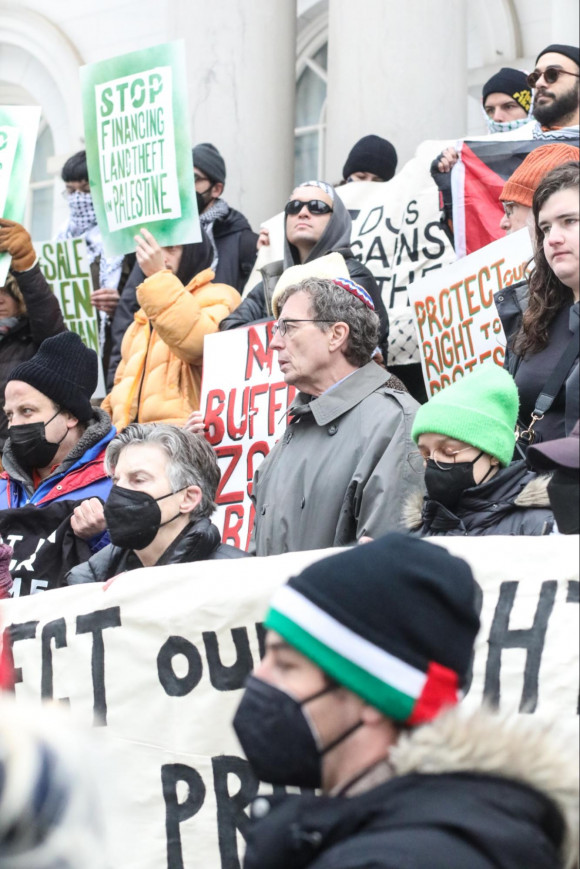
Outside on the City Hall steps about 40 people rallied opposing the bill, arguing it violates constitutionally protected rights to free speech and the right to protest. Many were carrying signs that read “Protect Our Right To Protest” while chanting “Free Palestine.”
Brooklyn School Board member Tajh Sutton said the bill is hypocritical in the face of many issues New Yorkers have faced for decades,
"What's funny about this hearing is that for so long the system has denied protection from hate to so many marginalized and hated groups whether black, LGBTQ, Palestinian, immigrant, etc. These people could never imagine a whole Five Point Plan for safety within this system just for them. So when they(Council) say educational institutions and houses of worship will be protected, we already know whose they are talking about. What’s even crazier is that when they talk about anti-semitism and protecting spaces of worship, they are never referencing semites of color in their protection,” said Sutton
“Multiple non-profit groups around the city stand as pillars around systemic problems within NYC rather than the actual legislative branch that should protect it”.
She further added these proposals often have more to do with making sure the protected classes in NYC stay safe and secure while still paying no attention to the plethora of marginalized communities that have been begging for attention from the city for decades now.
At one point during the chanting, a Jewish passerby remarked, “Yes guys, let them keep killing the Jews…keep it up!” sarcastically, underscoring the intense controversy and often undermined complexity of the disagreement between pro-Jewish residents and anti-Zionists on the Genocide in Gaza, not-so subtely representing the need for honest dialogue.
Initially the Buffer Zone bill proposed a 100-foot security perimeter around houses
of worship, an enhanced distance on that proposed by Governor Kathy Hochul’s 25-foot perimeter. The 100-foot proposal was shot down by Police Commissioner Jessica Tisch. She had concerns with the initial drafting of the bills, wanting to keep that “the language of the bill maintains the NYPD’s flexibility to both protect houses of worship and facilitate first amendment rights,” NYPD spokesperson Delaney Kempner said in a statement at the hearing.
During the hearing, which was well attended with those signed up to speak filling the gallery, early discussion between Council members, NYPD and testifiers sought to define what the bill would do beyond what already took place in the Human Rights Commission, when police considered safety issues around protests. As the city grappled with how best to address antisemitism and hate, the hearing explored several legislative strategies put forth in Introductions 1-A and 175, amongst others. These proposals would require the NYPD to create and publicly share a detailed plan outlining its response to injury, intimidation, and interference, all while upholding constitutional rights. Central to these bills are the principles of transparency and accountability in the application of existing law. Notably, the legislation does not establish new offenses or seek to criminalize protest activity.
Many sitting leaders at the hearing were for the proposal of strengthening these buffers, broadening the scope of safety past the violence of anti-semitism but to all houses of worship and places of education to maintain their safety and purity.
“Today, we stand united to ensure that New York City remains a place where all people feel included, safe, and valued,” said Council Member Salaam, Chair of the Committee to Combat Hate. “The recent rise in hate crimes, whether the spray-painted anti-religious graffiti at the Church of Jesus Christ of Latter-day Saints in Harlem, the hateful anti-Black racist comments made during the recent CEC3 meeting, anti-Muslim attacks in Bay Ridge, or antisemitic vandalism in Gravesend Park, reminds us that the work is far from over.”
During a press conference later in the day, Mayor Mamdani was asked for comment on the bill “The latest version of the legislation that you're referring to ask the Law Department and the NYPD to respond within 45 days with a plan to both the Speaker and myself on how we can both protect the right to prayer as well as the right to free speech…I look forward to seeing the hearing today and to seeing whatever the final version is of that legislation”.
We will continue to monitor this story in the coming days.